Showing posts with label science. Show all posts

Thursday, September 25, 2014

Ecology: The Water Cycle

The Water (Hydrologic) Cycle:

From the beginning of time when water first appeared, it has been constant in quantity and continuously in motion. Little has been added or lost over the years. The same water molecules have been transferred time and time again from the oceans and the land surface into the atmosphere by evaporation, dropped on the land as precipitation, and transferred back to the sea by rivers and groundwater. This endless circulation is known as the "hydrologic cycle". Water is the the only natural substance which exists at the surface of the earth in three states:  solid (ice), liquid (water), and gas (water vapor).  In order to change the state of water from one form to another, heat is needed. In the natural environment, this heat energy comes from the sun.

Oceans represent 97.24 percent of all the Earth's water.  All of the water in lakes and rivers will eventually end up in an ocean, and it is the oceans of the world which undoubtedly contribute most of the water vapor in the atmosphere.  As a result of the oceans' impact on the water cycle, it is no wonder why oceans influence weather and climatic condition of the globes.

Water source
Water volume, in

cubic miles
Percent of

total water
Oceans317,000,00097.24%
Icecaps, Glaciers7,000,0002.14%
Ground water2,000,0000.61%
Fresh-water lakes30,0000.009%
Inland seas25,0000.008%
Soil moisture16,0000.005%
Atmosphere3,1000.001%
Rivers3000.0001%
Total water volume326,000,000100%
Table 1: Global water distribution

Source: Nace, U.S. Geological Survey, 1967 and

The Hydrologic Cycle (Pamphlet), U.S. Geological Survey, 1984

The biggest determinant in water quality is what water runs over ex.: unpolluted soil, porous rocks, or concrete. Let's look at the three most common environments we live in...

The Rural Water Cycle includes fields, woodlands, and streams. Because of this, as long as humans don't pollute these areas, the water is cleaner than water coming off road ways. Their are other concerns for water in these areas though, like bacteria, animal pollutants, and stagnant water. Humans must never drink from a water source they are unsure of as bacteria in the water can make us sick.

The Suburban Water Cycle includes small neighborhoods where houses using wells and city water add possible contaminants like pesticides, heavy metals, paints, oils, and gas. Some neighborhoods use septic systems where contaminated water from toilets and sinks is pumped into an underground storage tank and slowly allowed to peculate to the surface.

Urban Environments need to use man-made waste treatment plants to clean the water of garbage, chemicals, and other dangerous materials before sending it back into the natural environment. Storm drains carry water from roads to Water Treatment plants while pipes from your bathroom carry dirty water to sewage plants where the water is cleaned and chemically sterilized before being sent by more pipes into streams or rivers.

-------------------
Watch the Introduction to the Water Cycle on the BBC website.

-------------------

Students will review the What is an Aquifer? site to learn about ground water.


-------------------

Vocabulary:

Condensation 

Water vapour is also emitted from plant leaves by a process called transpiration. Every day an actively growing plant transpires 5 to 10 times as much water as it can hold at once.

Sublimation

The changing of water from a solid to a gas.

Surface runoff

Excessive rain or snowmelt can produce overland flow to creeks and ditches. Runoff is visible flow of water in rivers, creeks and lakes as the water stored in the basin drains out.

Precipitation

Precipitation is made up of any type of water that falls to the earth like snow, hail, mist, or rain. Most of it (80 percent) evaporates or transpires through plants and never reaches lakes, streams, or ground water. The rest, about 6-10 inches of precipitation, runs off the land into lakes, streams, wetlands or rivers (also called "surface water"), or, it soaks right into the ground.

Percolation

Some of the precipitation and snow melt moves downwards, percolates or infiltrates through cracks, joints and pores in soil and rocks until it reaches the water table where it becomes groundwater.

Infiltration

Infiltration happens when water soaks into the soil from the ground level. It moves underground and moves between the soil and rocks. Some of the water will be soaked up by roots to help plants grow. The plant's leaves eventually release the water into the air through the plant's pores.

Some of the water keeps moving down into the soil to a level that is filled with water, called ground water. The very top of this layer filled with ground water is called the water table.

Ground Water

Ground water is simply water under the ground where the soil is completely filled or saturated with water. This water is also called an "aquifer." Ground water moves underground from areas where the elevation is high, like a hilltop, to places that are lowland areas. Water movement is slow and might move anywhere from less than a millimeter up to a mile in a day.

Where the water table meets the land surface, a spring might bubble up or seep from the ground and flow into a lake, stream woodland, or the ocean. Ground water that meets the land surface also helps keep rivers, streams, lakes and wetlands filled with water.

The Water Table

The Water Table is found underground where the rock and soil begin to be filled or "saturated" with water. It also marks the very top of the ground water layer.

Where the water table meets the land surface, a spring might bubble up or seep from the ground and flow into a lake, stream woodland, or the ocean. When ground water meets the land surface, it flows out and helps keep rivers, streams, lakes and wetlands filled with water.

Evaporation

Warmth from the sun causes water from lakes, streams, ice, and soils to turn into water vapor in the air. Almost all of the precipitated water (80 percent) goes right back into the air because of evaporation. The rest runs off the land or soaks into the ground to become ground water.

Water Vapor

Water vapor is water in a gas form that is held in the air until it changes back to water. You know, sometimes it #s sticky outside in the summer - that #s just water held in the air. The water can change into fine droplets by "condensing" in the air, and we get clouds. When the droplets get big enough, they are pulled to the earth by gravity as precipitation, better known as rain, sleet, snow, hail, dew, or frost.

Transpiration (evaporation of water from plants):

Plants give off water from their surfaces in a process called transpiration. This water leaves through stomata, which are tiny openings on the surface of a plant and are especially abundant on the undersides of leaves. Stomata open and close to let gases in and out. Water vapor is one of the released gases. Some leaves have more than a million stomata. In forests, trees need a large amount of water because about 98 percent of the water they take in is lost through the stomata. The leaves of tropical and temperate plants have stomata that are open longer periods of time and have larger openings than those of desert plants. In the desert, plants can survive with less water because the stomata of the plants do not open as wide and remain closed most of the time. The time stomata remain open as well as the size of their openings are largely controlled by the availability of water and of sunlight.

As the water evaporates from leaves during transpiration, more water is pulled into the plant at the roots. The water moves from the roots to the leaves through tubelike structures called xylem tubes. The water carries nutrients through plants.

-------------------

The Water-Climate Relationship

Water plays a basic role in the climate system through the hydrologic cycle, but water is intimately related to climate in other ways as well. It is obvious, from a water resource perspective, how the climate of a region to a large extent determines the water supply in that region based on the precipitation available and on the evaporation loss. Perhaps less obvious is the role of water in climate. Large water bodies, such as the oceans and the Great Lakes, have a moderating effect on the local climate because they act as a large source and sink for heat. Regions near these water bodies generally have milder winters and cooler summers than would be the case if the nearby water body did not exist.

The evaporation of water into the atmosphere requires an enormous amount of energy, which ultimately comes from the sun. The sun's heat is trapped in the earth's atmosphere by greenhouse gases, the most plentiful of which by far is water vapour. When water vapour in the atmosphere condenses to precipitation, this energy is released into the atmosphere. Fresh water can mediate climate change to some degree because it is stored on the landscape as lakes, snow covers, glaciers, wetlands and rivers, and is a store of latent energy. Thus water acts as an energy transfer and storage medium for the climate system.

The water cycle is also a key process upon which other cycles operate. For example one needs to properly understand the water cycle in order to address many of the chemical cycles in the atmosphere.

-------------------

Assessment Projects:

#1: Transpiration Activity:

Purpose
To determine how the number of stoma affects water loss.

Materials
4-by-8-inch (10-by-20-cm) piece of poster board
two 10-ounce (25-cm-diameter) plastic cups
pencil
scissors
paper hole punch
tap water
black marking pen
transparent tape

Procedure
  • Fold the poster board piece in half by placing the short sides together.
  • Stand one of the plastic cups upside down on the poster board.
  • Use the pencil to trace around the mouth of the cup on the poster board.
  • Cut out the circle tracing, cutting through both layers of the poster board.
  • Use the paper hole punch to cut 2 holes in one of the paper circles, one hole across from the other.
  • Randomly cut 20 holes in the other paper circle.
  • Fill the cups with an equal amount of water so that they are about three-fourths full with water.
  • Use the pen to mark a line on each cup that is even with the surface of the water.
  • Use the tape to secure the edges of one paper circle over the opening of each cup. You want the holes in the circle to be the only openings.
  • Set the cups near a window that gets direct sunlight.
  • After 3 or more days, compare the level of the water in each cup to the black water mark on each cup.


Results
There is less water in the cup with many holes in its cover than in the cup with only two holes in its cover.

Why?
The fact that the water level goes down shows that water has left the cups. Water in the cups evaporates, forming water vapor, which escapes through the holes in the covering. The amount of vapor escaping increases with the number of holes in the covering. The holes represent stomata in the leaves of plants. The more stomata in the leaves, the greater the amount of water lost by transpiration. Desert plants have fewer stomata, which are closed most of the time, as well as stomata with small openings, so they lose a smaller amount of water than do other plants, which have leaves containing many large stomata that are open most of the time.

#2: Students will create a Mini Water Cycle Terrarium.

#3: Students will create a Water Cycle Disk.


#4: Students will create a bulletin board showing the different aspects of the Water Cycle:

Water Cycle 2 by misskprimary

Ecology: Working from the ground up.

Ecology is the scientific analysis and study of interactions among organisms and their environment, such as the interactions organisms have with each other and with their abiotic environment. 

For this post, we will be looking at the health of our local soil and water supply.

There are three soil components – Clay, Sand and Silt

Clay is the smallest mineral component. These tiny flat particles fit closely together to have the greatest surface area of all soil types. Clay soil contains needed nutrients and also stores water well. So well in fact, that drainage is slow in clay soil. It is the slowest to warm in the spring.

Sand makes up the largest particles in soil. They are rounded, rather than flat. This allows for larger space between the particles and water drains quickly.  Because of this, the nutrients drain faster than clay soil and your plants will need more water and fertilizing.

Silt represents the middle size pieces. It is made up of rock and mineral particles that are larger than clay but smaller than sand. Individual silt particles are so small that they are difficult to see. To be classified as silt, a particle must be less than .005 centimeters (.002 inches) across.

The Mason Jar Soil Test

Use a clear, clean, empty jar with a tight lid. A pint or quart Mason jar works fabulously.

Fill the jar about half full of garden soil. You can use soil from different areas of the garden to get an overall view, or make a test for each garden bed.

Fill the jar nearly to the top with water. Leave room for shaking.

Tighten the lid and shake the jar for several minutes so that all the particles are in suspension.
Set your mason jar soil test aside for several hours, so the particles have a chance to settle. They will separate into clay, silt, and sand layers.

Read the Results of your Mason Jar Soil Test
  • The bottom layer will be the heavier particles, sand and rocks
  • The next layer will be the silt particles
  • Above that are the clay particles
  • Organic matter may be floating on the surface of the water
The color of the soil gives a clue to its character – light colors usually have less organic content than dark soils and dark soil warms faster in the spring.
  • If your jar test is 20% clay, 40% Silt, 40% sand = Loam, you have the perfect combination
  • 30% clay, 60% silt, 10% sand = Silty Clay Loam
  • 15% clay, 20% silt, 65% sand = Sandy Loam
  • 15% clay, 65% silt, 20% sand = Silty Loam
#1 – You can test your soil pH with vinegar and baking soda

Collect 1 cup of soil from different parts of your garden and put 2 spoonfuls into separate containers. Add 1/2 cup of vinegar to the soil. If it fizzes, you have alkaline soil, with a pH between 7 and 8.

If it doesn’t fizz after doing the vinegar test, then add distilled water to the other container until 2 teaspoons of soil is muddy. Add 1/2 cup baking soda. If it fizzes you have acidic soil, most likely with a pH between 5 and 6.

If  your soil doesn’t react at all it is neutral with a pH of 7 and you are very lucky!

#2 – You can make a cabbage water pH test

Measure 2 cups of distilled water into a sauce pan. Cut up and add 1 cup of red cabbage. Simmer for 5 minutes. Remove from heat and allow it to sit for up to 30 minutes.

Strain off the liquid – which will be purple/blue. This will have a neutral pH of 7.

To test: add 2 teaspoons of soil to a jar and a few inches of cabbage water. Stir and wait for 30 minutes. Check the color. If it turns up pink, your soil is acidic.  If it is blue/green, your soil is alkaline.

Thank you Preparednessmama for posting these!

Soil and Water Test Kits:

For those wanting a more in-depth evaluation of your soil there are two options I'd like to recommend:


This is a good kit for small plots of land like school gardens. It's also a good kit if you are trying to show a small group of students results without spending too much.


We use the University of Florida's Extension Service to test our ground water and soil composition each season. They don't cost very much and you get a detailed report back in a few weeks.

Wednesday, August 20, 2014

Science/Oceanography: Mangroves


Lesson: Mangroves

Class: Oceanography

Grade Level: Fifth

Online Components:
Quiz Assessment on QuizWorks.
·        Virtual Mangrove Tour at the Smithsonian Institution.
·        Mangrove Predators by BBC One
o   © 2011 BBC One and Blue Planet
·        Mangrove Biology Worksheet by National Geographic.
o   ©2010 National Geographic Society
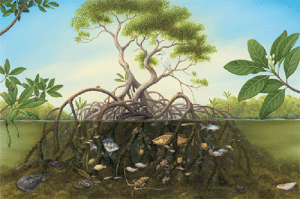
·        Layers of Life image by National Geographic.
o   ©2011 National Geographic Society
·        Mangrove Ecosystem coloring page by National Geographic.
o   © 1996–2014 National Geographic Society
·        Differences between Red, Black, and White Mangroves by the Nature Foundation of St. Maarten.
o   © 2009 Nature Foundation St. Maarten

Learning Objectives: Students will learn the different features of a Mangrove forest including the three types of mangrove trees found in our geographic area. Students will also learn about mangrove fish nurseries and some of the major threats mangroves are subject to including human and natural habitat destruction/pollution.

Time Allotment: 1 week (4 hours in class & 2 hours in the field (and/or virtual tour))

Activities (edited from National Geographic Education website):

1. Build background on mangrove ecology.
Explain to students that the tropics are a climate region generally found between the Equator and the Tropic of Cancer and the Tropic of Capricorn. There are 70 species of mangroves that live in the tropics and also the subtropics. Explain to students that the subtropics are a climate region found north of the Tropic of Cancer and south of the Tropic of Capricorn. The subtropics are between 20-40 degrees latitude in both hemispheres. There are three primary species of mangroves that live in the tropics and subtropics in the United States. Distribute copies of the handout Mangrove Biology to each student and have students read it independently or in small groups. Use the images to point out the different features of the red, white, and black mangrove trees that live in the tropical and subtropical regions of the world.

Post the Layers of Life pdf to show how mangroves fit into the coastal ecosystem. Watch the Mangrove Predators BBC One Blue Planet Clip on the BBC One website and the longer clip on Mangrove Nurseries in class.


2. Preteach the vocabulary.
Make sure students know the terminology for the different parts of a mangrove tree. Write on the board the vocabulary terms listed below. Use the definitions from the handout to help familiarize students with the terms.

Mangrove Vocabulary List:
Anoxic
adjective
No oxygen in the environment
Drop Roots
noun
Roots that drop down from the branches of red mangrove trees and set shoots into the ground
Ecology
noun
The study of the environment and its related communities. Eqios = the home, ology = the study of; "the study of the home"
Lenticel
noun
A small opening on the exposed roots of a tree that allows the plant to take in air to send to the rest of the root system
Pneumatophore
noun
The snorkel root of a tree
Prop Roots
noun
Roots of the red mangrove that keep the trunk of the mangrove out of the salt water
Salt Excluder
noun
An organism that will not let salt enter into itself
Salt Excreter
noun
When an organism pushes salt out through its pores
Sediment
noun
Underwater soil
Substrate
noun
Underlayer; something to hold on to or attach to

Oil Spill Cleanup Vocabulary List:
Boom
noun
An oil containment device that floats on the surface of the water and is used as a barrier to keep oil in or out of a specific location
Dispersants
noun
Chemicals that are sprayed on oil to cause it to break up and sink
Skimmers
noun
Skimmers use a floating boom system to sweep oil across the water surface, concentrating the oil to make the skimming process more effective and efficient.

3. Discuss the difference between Mangrove types.
  • Students will discuss the differences between Red, Black, and White Mangroves as described by the Nature Foundation of St. Maarten. Have students color the Mangrove Ecosystem Worksheet and write in the vocabulary terms where appropriate.


On-line research sites: 
Students may review the following online sites for more information (no issues should arise with this research as the pages do not have any specialized software requirements).

NOAA: http://www.habitat.noaa.gov/abouthabitat/mangroves.html
Smithsonian Ocean Portal: http://ocean.si.edu/ocean-life-ecosystems/mangrove-forests
Environmental Protection Agency: http://water.epa.gov/type/wetlands/mangrove.cfm
World Wildlife Fund:
http://wwf.panda.org/about_our_earth/blue_planet/coasts/mangroves/mangrove_ecosystems/
National Parks Service: http://www.nps.gov/ever/naturescience/mangroves.htm
Wikipedia: http://en.wikipedia.org/wiki/Mangrove
  • Hand out the Two-column chart. Have students write down Human-created problems in one column and Nature-created problems in the second column.
  • Hand out the Three-column chart. Have students write down the key biological differences between Red, Black, and White Mangroves.


4. Create flash cards
Have students work together to create flashcards on mangroves, the ecosystem, and issues related to damage of the mangroves. Students can photocopy and laminate cards so everyone has a set.


5. Class Trip.
Students unable to attend the in-class tour will explore the Virtual Mangrove Tour while the in-class program will go visit a local Mangrove forest and discuss the differences in person.

Mangrove pictures from class trip:

Black mangroves (tall); White mangroves (short)
Black mangroves leaves (back); White mangrove leaves (front)
Black mangroves
Black mangrove leaves with salt
Red mangroves with prop roots
Red mangrove seeds (Propagules)
White mangrove
White mangrove seeds
Videos from class trip:


Mangrove Tour August 2014

6a. Assessment 1 (on-line)-Mangrove Forest Quiz
Students will take the 5 question multiple choice quiz on QuizWorks as a mini-self assessment.

6b. Assessment 2 (in class)-Bulletin Board Task
Students will be broken up into three groups and each given one of the types of mangroves (black, white, red) to create a bulletin board of showcasing the types of plants, animals, and issues found in each. Students will use the internet and books from the library to research the three main types (see above #3).

At the end of the project, students will present their boards to the class describing some of the key features of their mangrove.

example found on pintrest
7a. Extra: Why are mangrove habitats important?

The mangrove roots hold the soft ground together and prevent erosion.
The roots help to keep the water clean and provide habitat for animals.
They provide nursery space for small animals.
Many living things (including people) use them to find food such as fish, shrimp, and clams.

7b. Extra: Things you can do to help protect mangrove habitats:

Walk on the boardwalk if there is one.
Do not let rubbish get washed down storm drains and into rivers.
Do not pour oil down the sink or drain.
Talk about mangrove habitats with friends and family.

Sunday, August 17, 2014

Science: NEWS!


Detectors dropped off by the Stardust probe in 2006 carried particles that may have originated in interstellar space.

Ian Sample, science editor
The Guardian, Thursday 14 August 2014 14.01 EDT

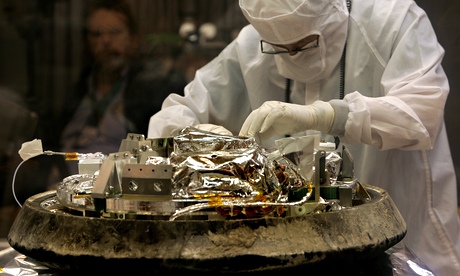
A technician unbolts a canister containing cometary and interstellar dust from the Stardust capsule.
It could be the most exotic material on the planet. Seven particles of dust brought back to Earth by a spacecraft nearly a decade ago appear to have come from beyond our solar system.

The specks have all the hallmarks of being created in interstellar space. If confirmed, it would make them the first material from outside the solar system to be brought to Earth for study.

Scientists found the tiny particles – including some shaped like fluffy snowflakes – on detectors carried by Nasa's Stardust probe which launched in 1999 on a mission to capture dust from interstellar space and the tail of comet Wild-2.

The detectors were dropped to Earth by parachute when Stardust flew past in 2006. Each detector worked like cosmic fly-paper and collected particles as they hurtled past the spacecraft.

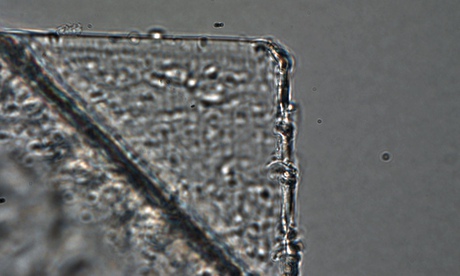
An optical microscope image of a track through aerogel made by Orion, one of the dust particles believed to be from interstellar space.

The dust might have been created in a supernova explosion millions of years ago and shaped by their exposure to the harsh extremes of space. "These are very precious particles," said Andrew Westphal, a physicist at the University of California in Berkeley, who worked on the dust.

The two largest fluffy particles contain a crystalline magnesium-iron-silicate mineral called olivine, which suggested that they came from the discs around stars and were altered by the interstellar environment, Westphal said.

If the nature of the dust is confirmed, then studies of the material could shed light on the origins of interstellar dust. Almost everything known about interstellar dust has come from observations, either with ground-based or space-based telescopes. "We seem to be getting our first glimpse of the surprising diversity of interstellar dust particles, which is impossible to explore through astronomical observations alone," Westphal added.
The international team of scientists sought help from more than 30,000 citizen scientists to scan thousands of microscope images in search of the particles. The largest of the particles was only a few thousandths of a millimetre across, considerably smaller than this full stop. Most of the specks weighed a few millionths of a millionth of a gram.

Two particles, named Orion and Hylabrook by their discoverers, were found from the tracks they left in detectors made from aerogel, an ultra-light and porous material. Scientists found a third track from a particle moving in the same direction, but it was evidently moving so fast, at more than 15km per second, that it vapourised on impact.

Four more particles, with the right chemical make-up for interstellar dust, were found at the bottom of pits left in thin aluminium foils built into the detectors. "They were splattered a bit, but the majority of the particles were still there at the bottom of the crater," said Rhonda Stroud at the Naval Research Laboratory in Washington DC. More tests are planned on the particles to confirm or rule out their interstellar origins.
Besides the exotic dust particles, researchers identified more than 50 other particles of spacecraft debris in the Stardust detectors, according to a report in Science.

Anton Kearsley, a microanalyst who took part in the study at the Natural History Museum in London, said recognising interstellar dust was a huge challenge.

"In the end, 30,000 people around the world worked through thousands of digital microscope images of the main part of the collector, the aerogel, and eventually found the tracks that included interstellar dust particles," he said.

"As the results came in, the numbers and sizes of dust grains were not what we'd expected, and many seemed to have come from strange directions," he added. "Only by careful plotting of impact directions was the team able to identify the seven particles that must have come from outside the solar system."